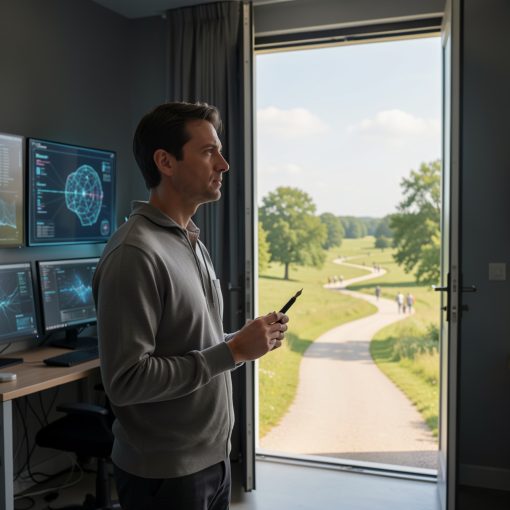

A person’s life is not made only of events. It is also made of witnesses.
There are people who remember us before a particular decision, before a relationship ended, before a career changed, before we learned how to speak more honestly. They know versions of us that no longer exist. Sometimes they remember those versions better than we do.
That is one of the quiet powers of human relationships: another person can carry part of the history of our transformation.
Artificial intelligence can remember information. It can store preferences, retrieve previous topics and recognise patterns in our language. That continuity can feel intimate. It can make a conversation appear to develop over time. But information is not the same as shared history.
A human witness did not merely read what happened. They were somewhere in the world while it happened. They had their own perspective, limitations, emotions and consequences. They may have misunderstood us. They may have been affected by our choices. They may have changed alongside us. Shared history is not just a database of facts; it is a relationship between lives.
This distinction matters at a time when people increasingly use AI for reflection and companionship. A chatbot can be easier to approach than a person. It does not interrupt in the same way. It does not need reassurance. It does not bring its own problems into the conversation. It may respond with remarkable patience and apparent understanding.
That accessibility can be beneficial, particularly for someone who feels isolated or finds it difficult to begin a vulnerable conversation. AI may offer a low-pressure place to practise words, explore an emotion or organise a confusing experience. Some research on companion AI suggests that users may become more open or vulnerable in human relationships after using such systems.
But the same convenience can become a problem when the AI becomes the primary witness of a person’s inner life.
A system may know what we have told it, but it does not know what it was like to stand beside us when we failed. It does not notice the silence after a difficult sentence in quite the same way a human does. It cannot independently remember the atmosphere of a room, the expression on someone’s face or the physical reality of being present during a crisis. It can generate a coherent account of our development, but coherence is not the same as participation.
Human witnesses also provide resistance. They do not always confirm our preferred interpretation. A friend may say that we are repeating an old pattern. A sibling may remember a promise we have forgotten. A colleague may notice that our new confidence has become impatience. These interventions can be uncomfortable, but they help keep our self-image connected to reality.
An AI designed to be agreeable may not provide enough resistance. Even a system instructed to challenge us remains a tool operating within a conversation we control. We can end the interaction, change the subject or ask for a different answer. Human relationships are more demanding because other people have agency of their own.
They may disagree. They may be unavailable. They may set boundaries. They may leave. Those qualities are not defects to be eliminated. They are part of what makes the relationship real.
This does not mean that every human relationship is healthy or that AI cannot be useful. Some people have limited access to supportive communities. Others may use AI during a period of grief, social anxiety or transition. The appropriate question is not whether AI should be used, but whether its use supports or replaces the wider network of life.
A useful exercise is to create a personal map of witnesses. Who knows where you came from? Who has seen you make a mistake? Who has witnessed a period of growth? Who can tell you something about yourself that you may not want to hear? Who would notice if you began withdrawing from the world?
The answers do not need to form a large circle. A few genuine relationships can be more important than a broad network of superficial contacts.
The exercise can also expose a gap. Perhaps there are not enough people nearby who know the current version of your life. Perhaps old relationships have faded. Perhaps work, illness, relocation or habit has reduced your contact with others. That realisation should not be treated as a personal failure. It is information, and information can become a starting point.
The first step might be a message to someone from an earlier chapter: “I was thinking about the period when we knew each other well. How do you remember it?” Or it might be an invitation to someone in the present: “I would like to spend more time together without having a specific reason.”
Such gestures are less efficient than asking AI for a conversation. They are also more uncertain. The other person may be busy, distracted or unable to respond in the way we hope. Yet the possibility of disappointment is part of the value. Relationships become meaningful partly because they involve another person’s freedom.
AI can help us prepare for these contacts. It can help formulate a message, identify what we want to say or reflect on what happened afterwards. But it should remain a bridge, not the destination.
A life needs witnesses who are not merely records of our words. It needs people who exist outside our control, who have changed themselves and who can meet us in the unfinished reality of the present.